ABEL PANN (1883 -
1963)
Abel Pann was born in Latvia in 1883. His father was a rabbi and
the head of a yeshiva (Jewish religious school). At an early age he showed interest in
drawing and studied in an art school in Odessa.
In 1903, he moved to Paris and continued his studies in an art academy. One of
his teachers was the French painter Adolphe William Bourguereau. His works aroused
much interest, winning him prizes and medals. His works were exhibited together with those
of Renoir and Matisse. He contributed to humoristic journals and was a member of the
"Salon des Humoristes" in Paris. In the course of time he became well-known in
the French capital.
In 1913, he went to Palestine and taught at the Bezalel Academy of Art for a
year. A few weeks before World War I broke out, he traveled to Paris, intending to return
to Palestine shortly afterwards. Because of the war he was prevented from doing so. When
it became known that pogroms had taken place in Russia, he drew paintings on that theme,
his purpose being to print reproductions of them. However, the Russian Minister in Paris
was informed of this project and succeeded in convincing the French government of the
necessity to forbid the printing. During the war, he painted war subjects, depicting
French patriotism and the French war effort. In 1917, he traveled to the
United States where the Union of Museums organized exhibitions of his works in several
cities. In 1920, he returned to Palestine to settle permanently and until 1924 taught
again at Bezalel. In 1921, he established the first lithographic installation in
Palestine, where lithographs of his works were made. In 1917, he traveled to the
United States where the Union of Museums organized exhibitions of his works in several
cities. In 1920, he returned to Palestine to settle permanently and until 1924 taught
again at Bezalel. In 1921, he established the first lithographic installation in
Palestine, where lithographs of his works were made.
Even before that date he began to paint biblical themes but thereafter dedicated
his work mainly to the Bible. Now he used pastel colors, whereas formerly he had painted
in oil. He viewed the Bible realistically and the people and landscapes of his paintings
are of the Orient, as he saw them in Palestine. This is one of the innovations of his
work.
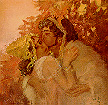 One of his critics pointed out that "this time the Bible is
seen by the eyes of Shem and not of Japhet and there is a feeling that this is the correct
interpretation." In the twenties and thirties he held many exhibitions in Western and
Central Europe. His works, including reproductions of them, are widely known all over the
world. One of his critics pointed out that "this time the Bible is
seen by the eyes of Shem and not of Japhet and there is a feeling that this is the correct
interpretation." In the twenties and thirties he held many exhibitions in Western and
Central Europe. His works, including reproductions of them, are widely known all over the
world.
|
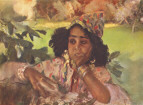 In the course of World War II, he
drew paintings of the Holocaust, but at the same time continued to paint themes of Eretz
Israel. In the course of World War II, he
drew paintings of the Holocaust, but at the same time continued to paint themes of Eretz
Israel.
Art critic David Giladi said of him: "Had Abel Pann not seen his vocation as
being specially Jewish, his name might have been among those inscribed in letters of gold
in the pantheon of French art".Today, Pann occupies a central place among the masters
of Eretz Israel. His works increase in value and are much sought after by collectors all
over the world.
In 1987, a major exhibition accompanied by an important and beautiful catalogue was presentd by Mayanot Gallery.
It was the first of a series of fine shows of the works of early 20th century Israeli
Masters shown by Mayanot Gallery.
In1989, Mayanot published "The Five Books of
Moses" with 84 color plates from the work of Abel Pann (in Hebrew, English and
French). In 1996, a second edition was published.
2000 - The Jewish Museum Vienna presented the exhibition of "Abel Pann - The painter of The Bible." An
accompanying catalogue was published with text by Shlomit Steinberg and Felix Salten.
2003 - The Israel Museum presented a major exhibition, "The Art of Abel Pann from Montparnasse to the
Bible." A substantial catalogue of the same title was published with text by Yigal Zalmona. Yael Gahnassia and Mayanot
Gallery were pleased to participate by loaning works.
2005 - Israel Museum pubished a catalogue edited by Yigal Zalmona for "Les amis du village suisse
d'enfants Kiriath Yearim."
|