SHMUEL CHARUVI (1897 - 1965)
"To paint the Land of Israel as I had imagined it from
afar" – thus, Shmuel Charuvi (Bokser) defined his artistic mission in 1953. This
mission – the graphic documentation and preservation of the Israeli landscape –
he set about to fulfill from the time of his arrival in the country from Odessa in 1914 at
the age of seventeen.
Charuvi's art owes no small debt to his student years (1914-17) at the Bezalel
Academy in Jerusalem. In those hard years of World War I, Charuvi belonged to the
charismatic group of students (including Menahem Shemi, Nahum Gutman, Joseph Levin, and
others) who were to shape the new Israeli art. This was the generation which absorbed the
influence of Abel Pann, who brought the Paris spirit to Jerusalem, leading its students
out of the studio and into nature, effecting their fateful introduction to the
Mediterranean sunlight. Thereafter, landscape would no longer be "holy places,"
but natural experiences in eastern light and color.
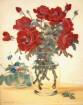
No less decisive in the creation of Charuvi's style were his
studies in the department of landscape painting and miniature painting.
Charuvi specialized in floral decorative painting, and vegetable
and animal ornamentation in the Jugendstil, Art Nouveau style. The lessons of his work in
those years are reflected in many of his later paintings. |
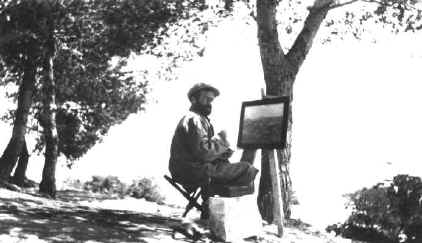
Most outstanding in Shmuel Charuvi's art is his landscape painting.
After he was demobilized from the Jewish Brigade in 1918, he began painting views of
Jerusalem, very like the biblical painters working in the old Bezalel style.
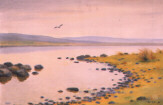
The artist's landscapes are indeed pictures of simplicity and
innocence, devoid of intellectual sophistication. They are paintings of love, in quest of
beautiful landscapes to be captured for all time. Sun, light, openness, idyll, spring,
blooming, translucence, clean palette, strong control of warm and cool color with a
partiality to warm yellow-orange tones, stasis, nearly always unpeopled – all these
typify his work.
Between the vanishing past and the unknown future Charuvi's art
stands as an effort to apprehend and conquer time. Only his powerful affinity with growth
and regeneration conveys his enduring interest in the ravages of time, in life, in the
refusal to surrender to fading, to the twilight of nature and man.
Charuvi's works are found in museums and private
collections around the world.
In 1990, a major exhibition accompanied by an important and beautiful
catalogue was presented by Mayanot Gallery.
It was the third of a continuing series of Fine Shows of works of early 20th
century Israeli Masters shown by Mayanot.
In 2006, the Israel Museum in Jerusalem presented a major exhibition "THE BOTANIST'S BRUSH -
Floral Treasury of the Land of Israel." The accompanying catalogue was edited by Tamar Manor-Friedman. |