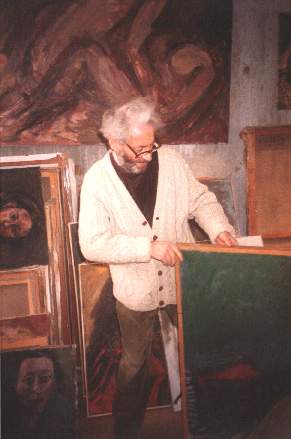
ISAAC CELNIKIER (born 1923)
The painter Isaac Celnikier lives and works in Paris, but
makes long visits to Israel. He was born in Warsaw in 1923. When the war started in 1939,
he was a youth of sixteen. The terrible years of persecution found him in the ghetto of
Bialystok, from which he was deported to the hell of Auschwitz. He survived. But the
horrors of Auschwitz left a deep mark on his personality and his art. After the war he
remained for some time in Poland, studied art in Warsaw and went to Prague. In 1957, he
left Poland and settled down in Paris. In 1967, he received the important prize -
Chevalier des Arts et des Lettres - from the French government.
The artist's spiritual strength is not only expressed in the denunciation
of the tragic past of his people, but also in his adaptation to life. His works include
paintings, watercolors, drawings and etchings. His paintings of "Montmartre,"
the beauty of the "Judean Hills" and a "Day of Khamsin" are beautiful
and strong portraits of these subjects.
To express himself, Isaac Celnikier uses a rich range of colors and a
mature technique. For his canvases on the subject of the ghetto's sufferings, we owe the
artist deep thanks. He gives life to what he cannot forget, and what we all forever must
remember.
"This testimony, it should be noted, with all its inability to cope
with the full awesomeness of the subject, is an island in the ocean of terror of the
Jewish tragedy called the Holocaust, but it is given an honest expression which arouses
credibility and respect. Celnikier brought with him, from the death camps, not only the
heartrending outcries of the tortured but also the silence of the millions whose voice was
stilled in the liquidated ghettos, in the mammoth common graves, in the gas chambers and
the crematoria."
Dr. Haim Gamzu Director, The Tel Aviv Museum, 1976
"That is to say that such a work cannot be reduced to a deposition
and that one can admire, with a joy mixed with painful recognition, this artist's oeuvre
as it prevents the work of mourning from accomplishing the mediocre metamorphosis of a
reconciliation with reality. Canvases and engravings manage to show, though without any
idealization, the inalienable humanity of these beings who were warehoused, transported
and 'treated' like bio-degradable garbage. For those whom form and color have restored
here are no longer martyrs, nor even Jews, but simply beloved ones who were murdered,
murdered ones who will always be beloved. And yet the one who sees the work of Isaac
Celnikier will understand that he who wrote that love is stronger than death did not live
either during or after that time."
Elisabeth de Fontenay |
 The works of
Isaac Celnikier are found in many museums in Europe, Israel and the USA. The artist also
took part in several important exhibitions: Warsaw in 1953,1956 and 1994; Denmark in 1954;
France in 1962; Carpentras in 1962; Tel Aviv, Israel at the Orith Gallery in 1966;
Jerusalem and Ein Harod in 1987; in 1968 even in Moscow and Peking; and numerous times in
Paris, the center of art.
In 2005 the Museum of Cracow presented the exhibition "Isaac Celnikier - "Paintings,Drawings and Etchings". An important
catalogue accompanied the exhibition.
Collections
The National Museum, Warsaw
Musee d'Art Moderne, Paris
The Israel Museum, Jerusalem
Museum of Art, Ein Harod
Lohamei Hagetthaoth Museum
Private collections in Poland, Czechoslovakia, Austria, France, England, USA and Israel
Isaac Celnikier is represented by Mayanot Gallery since 1986
|